
What to Expect From 24/7 Emergency AC Repair, Start to Finish
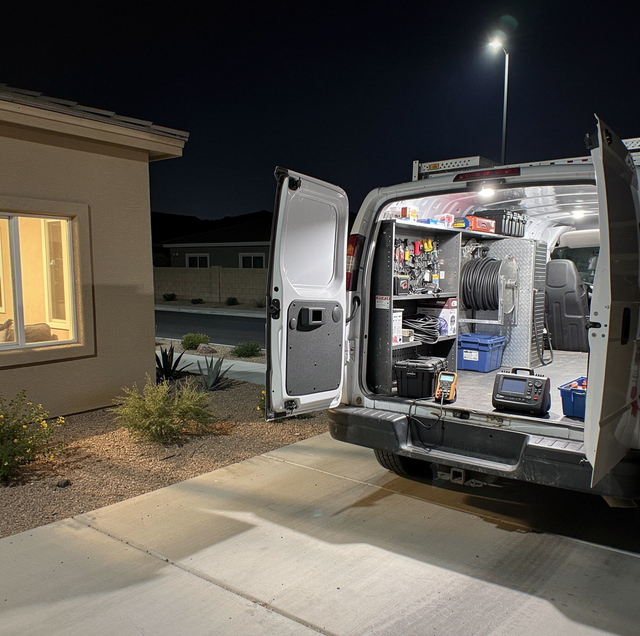
You call after midnight, and the line does not ring into an empty office. It reaches a technician already on call for that block of hours, with a truck loaded before your call comes in. The same holds at every other hour of the week, weekends and holidays very much included, and your air conditioner can fail on you at 3 a.m. and still reach a real person.
That structure lets you reach a person rather than a machine that takes messages. You give the dispatcher your address, a callback number, and what your system is doing, and that decides how fast a truck reaches the house. You are not on tomorrow's list; you are the next stop on a route already running tonight.
How an After-Hours Call Reaches a Real Technician
The number you call after dark is the same number you would call at noon; nothing about it changes after 5 p.m. What changes is who is standing by to pick it up. After hours, that is a technician on call, not an office, so whoever picks up the phone already knows what an air conditioner sounds like when it is failing and is not writing your answers down for someone else to read later.
That technician asks a brief set of questions before anything else: what the system is doing, when it started, and whether you smell anything unusual or hear a sound that wasn't there before. Those answers narrow which parts are likely candidates before the truck leaves, so the technician arrives with a short list in mind, not a blank one. Expect one instruction back: shut the thermostat off and cut the breaker until the truck arrives.
Keep your outdoor unit's model and serial numbers on your phone before you call, and clear a path to both the indoor and outdoor units so the technician can start working the moment the truck arrives.
What Counts as an Emergency and What Can Wait
Not every AC problem justifies a call at 2 a.m. A system that has completely stopped in extreme heat is not the same as one that is simply running warmer than usual.
| Situation | Emergency call | Can wait for a scheduled visit |
|---|---|---|
| System stopped entirely during extreme heat | Yes | No |
| Water pooling near the indoor unit | Yes | No |
| Burning smell or visible smoke | Yes | No |
| Airflow weaker than usual but still cooling | No | Yes |
| Occasional short cycling that still cools the house | No | Yes |
| Higher-than-normal utility bill with normal cooling | No | Yes |
That difference is not about comfort. It is about whether waiting until morning risks more damage or a real safety issue.
What Rusts First When a Condensate Line Backs Up?
A clogged condensate line is one of the quieter reasons a routine issue turns into an emergency call. The evaporator coil sheds water constantly while your system runs, and that water is supposed to leave through a dedicated drain line into a drain or outdoors. Hard water leaves mineral scale inside that narrow line, and algae quickly adds to the buildup, so the passage narrows gradually long before it closes completely. Once it clogs completely, the water has nowhere left to go but back up into the drain pan sitting underneath the coil. A pan built to catch the occasional overflow was never designed to hold standing water for days, and the sheet metal at its seams is usually the first surface that starts to rust once it sits wet.
A rusted pan does not fail all at once. It weeps first, at a seam or a screw hole, and that slow drip eventually reaches drywall, insulation, or a ceiling below before anyone notices the pan itself. A float switch mounted in the pan is built to shut the system down before that happens, cutting power the moment the water rises past a set point, so the leak stays confined to a pan that gets replaced, not a ceiling that gets rebuilt.
What the Technician Checks Before Opening Any Panel
Every visit starts with the disconnect at the outdoor unit and the breaker at your electrical panel, checked before a single screw comes off. A tripped breaker that resets and holds points one direction; one that trips again within seconds points somewhere else entirely. The technician also walks the outdoor unit itself, checking the coil, fan blade, and refrigerant lines for anything obviously wrong before power is ever restored to any component that might have caused the trip. That order protects whatever caused the trip from a second hit of power before anyone looks closely.
Once power is confirmed safe to restore, a multimeter and a set of gauges complete the diagnosis. Voltage at the contactor, amperage draw at the compressor, and pressures on both sides of the refrigerant circuit each rule things in or out, one reading at a time. None of that work involves guesswork about which part failed; it is measured directly with instruments built for exactly that job before any part is replaced on your system.
Why Nights and Weekends Are Treated Like Any Other Call
Nights, weekends, and holidays are treated the same as a weekday afternoon call. That is a deliberate choice, not an accident of scheduling, because a system that fails at 9 p.m. on a Saturday is no less an emergency than one that fails at 9 a.m. on a Tuesday. Nothing about how the visit is handled changes because of when the phone rang: the same questions, the same instruments, and the same bill at the end of it, whatever the clock happens to say.
What actually determines how a call gets handled is what the system is doing, not the day on the calendar. A no-cool call on a holiday gets the same triage as a no-cool call on a Wednesday: symptoms first, then a technician dispatched to match them. Keeping that policy consistent removes one more thing you have to weigh at 2 a.m., when deciding whether a problem is bad enough to justify calling is already hard enough. It leaves that decision resting on the symptoms alone.
How Long an Emergency Repair Actually Takes
Most emergency repairs finish in a single visit, within one to two hours on-site, because the failures that strand a system overnight are usually common, well-stocked parts.
A part that has to be special-ordered is the exception. When that happens, the technician stabilizes the system for the night and schedules the follow-up before leaving.
What Gets Left Behind After the Repair
A completed emergency visit should leave you with more than a running system. A written summary of what failed, which part was replaced, and what the electrical and refrigerant readings were at the time gives you something concrete to keep, not just a verbal explanation you have to remember correctly at 3 a.m. That summary also becomes the record a warranty claim or a future visit gets measured against, so nothing about that night depends on memory alone.
That record matters most the next time something goes wrong, because a technician looking at a new failure benefits from knowing what already happened at this address. It also matters if you want a second opinion on the diagnosis: a reading taken and written down at 3 a.m. can be checked against a reading taken in daylight, which is not possible if nothing was written down at all.
Ask for a written copy of the technician's notes before they leave; a record of the readings taken that night makes any later comparison much faster.
What a Second Look Would Add to a Midnight Diagnosis
A diagnosis made at 3 a.m., by flashlight, in an attic or a side yard, is not automatically wrong, but it is made with less to see than the same job done at noon. A second look in daylight can catch a wiring detail hidden in a shadow, a coil edge that was hard to inspect fully in the dark, or a duct connection that only shows a problem once the system has run for a while under normal daytime load.
None of that means the overnight repair was unnecessary. It means a second look, even a short one during a routine maintenance visit later, can confirm the fix held and catch anything the first visit could not fully see. Asking for that follow-up takes nothing but the question, and it turns one emergency call into two data points about the same system, not just one, that are worth comparing side by side.
Frequently Asked Questions
Arrival time depends on where the truck already is, not on how urgent your problem feels to you. A call placed at 2 a.m. often gets a faster response than one placed at 6 p.m., because fewer calls compete for the same technician. You usually get a window rather than an exact time, plus a callback to your phone if that window shifts.
No. Nights, weekends, and holidays are billed the same as any weekday call, so the time on the clock does not change what you owe. What changes is which technician answers and how many other calls are already stacked ahead of yours that night. Your bill reflects the repair, not when you asked for it.
Most single-system failures get resolved in one visit, because the truck carries the parts that fail most often on your equipment. A repair that needs a special-order part is the exception, and when that happens, the technician tells you what is on order, gives you a way to manage the heat if one exists, and schedules the follow-up before leaving your house, so you are not left guessing when the second visit happens or what it will involve.
Yes, you should expect it. A capacitor that fails due to heat stress often takes a contactor or a fan motor down with it immediately, so a technician who only replaces the part that failed is leaving a second failure in your system. Testing nearby components on the same call keeps you from booking a second visit for a problem that was sitting next to your first one.
A visit worth the call ends with an explanation, not just a working system. Ask what failed, why it failed, and what that means for the rest of your equipment going forward. A technician who found a bad capacitor should tell you whether the compressor it was protecting still tested within range, because that is the part you cannot see for yourself once the panel closes.
An emergency visit is built to get your system running again that night, not to finish every diagnostic step a daytime visit allows. If your unit is cooling again but the underlying cause was never confirmed, the technician should tell you so before leaving, rather than treating a temporary fix as permanent. A follow-up visit in daylight, with better visibility into the attic, the electrical panel, and airflow at each vent, catches things a flashlight and a ladder at midnight cannot. If the system fails again within days, mention your original visit; a repeat failure on the same part usually points back to something the first call could not test.
Get a technician on the way right now — a real 24/7 emergency call gets the same fast response and the same no-surcharge treatment every time, whether it lands during a quiet weeknight, a busy weekend, or a family holiday gathering. Modern Air Conditioning & Heating LLC serves Boulder City, Las Vegas, and Henderson. NV C-21 #0081442. Call (702) 919-4365.
