
AC Blowing Warm Air on a Hot Day? What’s Going Wrong
Quick Answer: Warm air from the vents almost always means the outdoor half of your system isn't doing its job — the indoor blower is still pushing air, but no heat is being removed from it. The DIY-fixable causes are a wrong thermostat setting, a clogged filter, a tripped breaker, or a blocked outdoor unit. The ones that need a technician are low refrigerant from a leak, a frozen coil, or a failed capacitor or compressor. On a 110-degree Vegas day, don't keep running it warm — that strains the compressor.
It's the worst possible timing: the hottest afternoon of the year, the AC is running, you can hear it, and the air coming out of the vents is room temperature or worse. Warm air from an air conditioner is one of the most common summer breakdowns, and the reassuring part is that several causes are things you can check in five minutes. The rest point to a specific failed part. Here's how to tell them apart.
Why "Running" Doesn't Mean "Cooling"
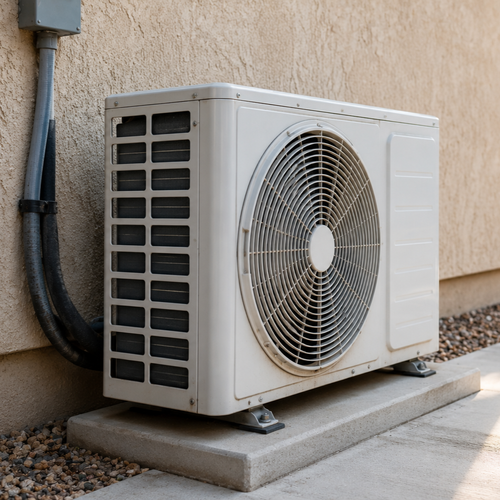
Your air conditioner doesn't make cold — it moves heat. The indoor unit blows your home's air across a cold coil, the refrigerant carries that heat outside, and the outdoor unit dumps it into the air and sends the refrigerant back cold. The indoor blower and the outdoor unit are a team.
That's the key to understanding warm air. The indoor blower can run perfectly while the outdoor unit sits dead, and when that happens, the fan just circulates the same warm household air without ever removing the heat from it. So "the AC is running but blowing warm" usually translates to "the indoor fan works, but the outdoor unit isn't pulling heat out." Most causes trace back to that outdoor half or to the refrigerant that connects the two.
Start With the Things You Can Check
Before calling anyone, rule out the simple stuff:
| Check | What you're looking for |
|---|---|
| Thermostat | Set to COOL (not HEAT), fan on AUTO (not ON), temp below room temp |
| Air filter | Clogged/gray filter chokes airflow — replace it |
| Breaker | The outdoor unit has its own breaker; reset a tripped one |
| Outdoor unit | Running? Clear of dust, weeds, debris? Any ice on the lines? |
Two of these deserve a note. If the fan is set to ON instead of AUTO, the blower runs nonstop even when the system isn't cooling, so you feel room-temperature air between cycles and think it's broken. And the outdoor unit has its own breaker that can trip in a heat wave — flip it fully off, wait five minutes, and back on. If the breaker trips again, stop and call a pro; a breaker that keeps tripping is a warning, not an inconvenience.
The Causes That Need a Technician
When the basics check out and the air's still warm, you're into territory that needs trained hands and, for anything involving refrigerant, EPA-certified handling.
Low refrigerant. Refrigerant is what makes the coil cold, and it runs in a sealed loop — it doesn't get "used up." So if it's low, there's a leak, and topping it off without fixing the leak just delays the next failure. A system low on refrigerant can't absorb heat and blows warm. This is a find-the-leak-and-repair job for a technician.
A frozen evaporator coil. It sounds backward, but a block of ice on the indoor coil makes the air warm — the ice insulates the coil so it can't do its job. The usual triggers are a dirty filter, starving airflow, or low refrigerant. If you see frost on the coil or the lines, switch the system off and let it thaw fully (don't chip at the ice), change the filter, and have the cause diagnosed.
A failed capacitor or contactor. These small electrical parts start and run the compressor and outdoor fan. When one fails — and extreme, sustained heat is hard on them — the outdoor unit won't start, so the indoor fan blows uncooled air. The capacitor is one of the most common heat-related failures.
A compressor problem. The compressor is the heart of the system. If it's failing or has overheated and shut down, the refrigerant cycle stops, and only warm air circulates. This is the most serious of the group.
If the air is warm, turn the system off rather than letting it run. Running a unit that can't cool keeps straining the compressor — the single most expensive part to replace — and a malfunctioning system left running can turn a small repair into a major one.
Why Vegas Heat Makes It Worse
Around Boulder City, Henderson, and Las Vegas, an air conditioner runs nearly nonstop for months — the area sees scores of days a year over 105 degrees and a handful over 110. That relentless duty cycle is hard on the parts that fail in the heat: capacitors, contactors, and compressors all work harder and hotter here than they would in a milder climate. Desert dust compounds it by caking the outdoor condenser coil, which then can't shed heat, so the system strains even more. It's why a seasonal tune-up that cleans the coil and checks the capacitor before summer pays for itself, and why warm air on a peak day is worth a fast service call rather than running the unit into the ground.
Frequently Asked Questions
Usually because the outdoor unit isn't removing heat, even though the indoor fan is still blowing. That can be a simple cause — a wrong thermostat setting, a clogged filter, a tripped breaker, or debris blocking the outdoor unit — or a part failure like low refrigerant, a frozen coil, or a bad capacitor or compressor. Check the simple things first, then call a technician.
Some of it. You can set the thermostat to COOL and the fan to AUTO, replace a clogged filter, reset a tripped breaker, and clear debris from the outdoor unit. If those don't fix it, the likely causes — refrigerant leaks, a frozen coil, electrical parts, or the compressor — need a technician, and refrigerant work legally requires EPA-certified handling.
A frozen coil usually comes from restricted airflow (a dirty filter or blocked vents) or low refrigerant. Either one lets the coil get too cold and ice over, and the ice then blocks cooling, so the air turns warm. Turn the system off, let it thaw completely without chipping the ice, replace the filter, and have the underlying cause checked.
Because refrigerant runs in a sealed loop and isn't consumed, "low" always means a leak. If it was topped off without the leak being repaired, it will run low again. The lasting fix is to find and seal the leak, then recharge to spec — which is a technician's job and requires certified handling of the refrigerant.
No — turn it off. Running a system that can't cool keeps straining the compressor, the most expensive component, and can turn a minor repair into a major one. Shut it down, run through the simple checks, and if the air's still warm, call for service rather than letting it labor in the heat.
The cooling season here is long and brutal, so the system runs almost constantly for months, and capacitors, contactors, and compressors wear faster under that sustained heat and load. Desert dust also clogs the outdoor coil, making the unit work harder to shed heat. Regular maintenance that cleans the coil and tests electrical components before summer reduces these failures.
Warm Air Is the Outdoor Unit Waving a Flag
When the vents get warm on a hot day, the message is almost always that the outdoor side of your system has stopped pulling heat out of your home. Run the quick checks — thermostat, filter, breaker, clear the outdoor unit — and you'll catch the easy fixes. Past that, it's a refrigerant, electrical, or compressor issue that a technician should handle, and the smartest move while you wait is to switch the system off so a small problem doesn't become a compressor.
AC blowing warm when you need it most? — Get the outdoor unit, refrigerant, and electrical parts checked fast before the compressor pays for it. Modern Air Conditioning & Heating LLC serves Boulder City, Las Vegas, and Henderson. NV C-21 #0081442. Call (702) 919-4365.
