
Signs Your AC Is Low on Refrigerant — and Why It Matters
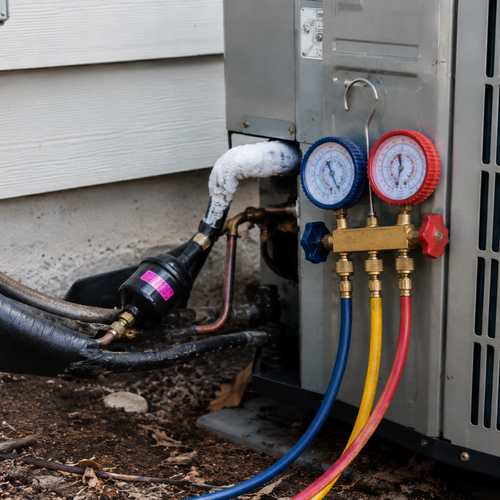
Quick Answer: Signs your AC is low on refrigerant include weak cooling that can't keep up, longer or constant run times, warm air from the vents, ice forming on the refrigerant lines or indoor coil, hissing or bubbling sounds, and higher energy bills. The crucial thing to understand is that an AC doesn't use up refrigerant — it circulates the same charge in a sealed loop. So if the level is low, there's a leak. That's why simply adding refrigerant isn't a real fix: it ignores the leak, the new refrigerant escapes too, and the underlying problem keeps stressing the system. The right fix is finding and repairing the leak, then recharging to the correct level.
When an air conditioner isn't cooling well, low refrigerant is a frequent suspect — and recognizing the signs helps you catch it early. But the most important thing to understand about low refrigerant isn't the symptoms. It's that the refrigerant doesn't get used up, so a low level always means a leak. That changes what the real fix is.
Refrigerant Doesn't Get "Used Up"
Here's the misconception that causes a lot of wasted money: many people think an AC consumes refrigerant the way a car uses oil or gas, needing periodic top-offs. It doesn't. Refrigerant circulates through a sealed, closed loop, absorbing heat inside and releasing it outside, over and over, without being consumed. The charge should stay the same for the life of the system.
So if your AC is low on refrigerant, the refrigerant went somewhere — it leaked out. That single fact is the key to everything else, because it means the goal isn't to replace lost refrigerant; it's to find and fix the leak.
The Warning Signs
Low refrigerant produces a recognizable set of symptoms, and they tend to appear together.
The most common is weak cooling — the AC runs but can't get the house to the set temperature, especially on hot days. With less refrigerant to carry heat, the system loses cooling capacity. That leads to longer and longer run times, even constant running, as the AC tries and fails to catch up. The air from the vents may feel only slightly cool or even warm.
A counterintuitive sign is ice. Low refrigerant lowers the pressure and temperature at the indoor coil, which can cause condensation to freeze into ice on the coil or on the refrigerant line outside. Ironically, an AC low on refrigerant can ice up and still blow warm air. You may also hear hissing or bubbling sounds, which can be the sound of refrigerant escaping through a leak.
| Sign | Why low refrigerant causes it |
|---|---|
| Weak cooling, can't keep up | Less refrigerant to absorb heat |
| Long or constant run times | System straining to reach the setpoint |
| Warm air from vents | Reduced cooling capacity |
| Ice on coil or refrigerant line | Low pressure freezes condensation |
| Hissing or bubbling | Refrigerant escaping a leak |
| Rising energy bills | System running far more to compensate |
Why "Just Add More" Is the Wrong Fix
Because so many people believe refrigerant gets used up, a common request is to just "top it off." The problem is that this treats the symptom and ignores the cause. If you add refrigerant without fixing the leak, the new refrigerant leaks out too, and you're back where you started — often within a season. You pay again, and meanwhile the system has spent that whole time running low and under stress. Worse, running an AC low on refrigerant can overheat and damage the compressor, the most expensive part of the system. So repeated top-offs aren't just wasteful; they let the real damage continue.
The correct approach is to find the leak, repair it, and then recharge the system to the proper level. That fixes the actual problem and restores the sealed loop the way it's supposed to be.
Don't keep running an AC that's clearly low on refrigerant — weak cooling plus ice on the lines is a classic sign. Running low strains and overheats the compressor, risking the costliest failure in the system. Shutting it off and having the leak found protects the expensive components.
Why It Matters Beyond Comfort
Low refrigerant is more than a comfort issue. The system works much harder for fewer results, driving up energy bills. The strain on the compressor risks an expensive failure. And the leak itself means refrigerant is escaping into the environment. Addressing it properly — leak repair plus recharge — solves the comfort problem, protects the equipment, lowers the energy waste, and stops the leak. That's a far better outcome than chasing the symptom with refills. There's also a timing benefit to acting early. A small refrigerant leak caught quickly often means a simpler repair and far less time spent running the system in a stressed, low-charge state. Let it go, and the leak tends to grow while the compressor absorbs the strain of running low all season, turning what could have been a modest fix into a much larger one. Because finding a leak and handling refrigerant requires proper equipment and certification, this is a job for a professional, who can locate the leak, repair it, and recharge to spec.
Frequently Asked Questions
Common signs are weak cooling that can't reach the set temperature, longer or constant run times, warm air from the vents, ice forming on the indoor coil or refrigerant lines, hissing or bubbling sounds, and rising energy bills. These often appear together. The combination of poor cooling and ice on the lines is an especially telling sign of low refrigerant.
No. Refrigerant circulates in a sealed, closed loop and isn't consumed during normal operation — the charge should last the life of the system. If your AC is low on refrigerant, it means there's a leak somewhere that lets it escape. This is why low refrigerant is always a leak problem, not a normal need for refills.
It sounds contradictory, but it's a classic low-refrigerant sign. Low refrigerant drops the pressure and temperature at the coil enough to freeze condensation into ice, while at the same time, the reduced charge means the system can't cool your home, so it blows warm air. The ice further blocks airflow, worsening the warm output.
Adding refrigerant without fixing the leak only treats the symptom. The new refrigerant leaks out too, often within a season, so you pay repeatedly while the system keeps running low and under stress. The correct fix is to find and repair the leak, then recharge to the proper level. Topping off alone lets the real problem continue.
Yes. Running low makes the compressor work harder and run hotter, which can lead to overheating and eventual failure — and the compressor is the most expensive part of the system. Low refrigerant also drives up energy bills and worsens cooling. Continuing to run an AC that's clearly at low risk of turning a leak repair into a major compressor replacement.
A professional locates the leak using specialized methods, repairs it, and then recharges the system to the correct refrigerant level. Handling refrigerant requires proper equipment and certification, so it's not a DIY task. Fixing the leak rather than just refilling restores the sealed loop and solves the underlying problem, protecting the system going forward.
Treat the Leak, Not the Symptom
Low refrigerant shows up as weak cooling, long run times, ice on the lines, and rising bills — but the real headline is that refrigerant doesn't get used up, so low always means a leak. That's why topping it off is a costly non-fix that lets the compressor keep suffering. Finding and repairing the leak, then recharging to spec, is the only approach that actually solves the problem and protects your system.
AC cooling poorly or icing up — Get the refrigerant leak found and repaired, then the system recharged the right way. Modern Air Conditioning & Heating LLC serves Boulder City, Las Vegas, and Henderson. NV C-21 #0081442. Call (702) 919-4365.
