
How a Clogged Condenser Coil Quietly Kills Your AC's Cooling
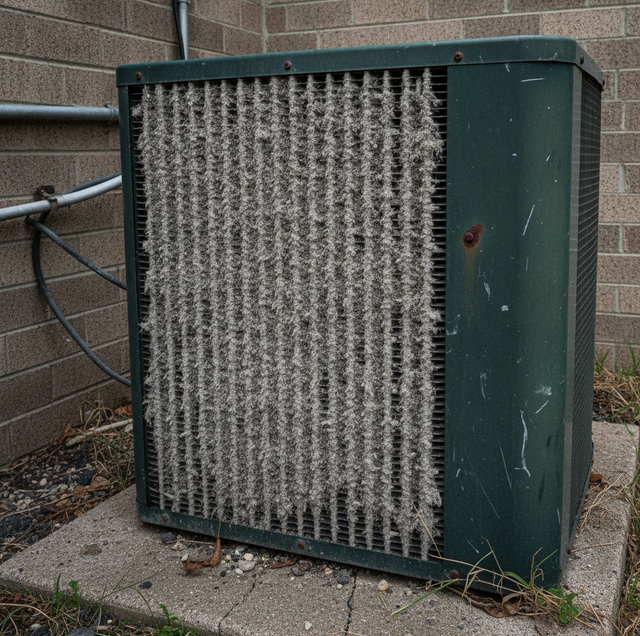
Your air conditioner does not make cold air so much as it moves heat out of it. It pulls warmth from the rooms inside, carries that heat outside through refrigerant, and dumps it into the open air. The single component that does the dumping is the condenser coil in your outdoor unit. When that coil gets buried in dust and debris, the heat has nowhere to go, and every part of the cooling process downstream starts to struggle. This is one of the most common reasons a system that worked fine last year suddenly runs all day without ever cooling the house.
Quick Answer: A dirty condenser coil traps the heat your AC is trying to release outdoors. Clean the coil by shutting off power at the disconnect and rinsing the fins gently from the inside out with a garden hose. Skip the pressure washer, keep two feet of clearance around the unit, and book an annual professional cleaning to protect the compressor.
What the Condenser Coil Actually Does
Look at the large metal box sitting outside your home. Inside it, wrapped around the perimeter, is the condenser coil: a maze of copper tubing threaded through hundreds of thin aluminum fins. Hot, high-pressure refrigerant vapor arrives from inside the house carrying all the heat the system collected from your rooms. A fan on top of the unit pulls outdoor air across those fins, and as the air passes over the metal, it carries the heat away. The refrigerant cools, condenses back into a liquid, and cycles back indoors to grab more heat.
Those fins exist for one reason: surface area. The more metal the passing air can touch, the more heat leaves the refrigerant. That design is also the coil's weakness. Anything that coats the fins or blocks the gaps between them chokes off the airflow that the whole process depends on.
How Dust and Debris Clog the Fins
The same fan that pulls cooling air across the coil also pulls in whatever is floating nearby. Dust, dirt, pollen, cottonwood fluff, grass clippings from mowing, and pet hair are all drawn toward the unit and pressed against the outer face of the fins. Over a season, a fine gray felt builds up across the metal. From a few feet away, the unit looks fine. Up close, the gaps between the fins are packed solid.
Several things speed this up. Landscaping right against the cabinet drops leaves and seeds directly into the airflow. A nearby clothes dryer vent throws lint straight at the coil. Construction or remodeling nearby loads the air with fine grit. And in a dusty, dry setting, ordinary wind-driven dust settles on everything, so a coil there collects a film faster than one in a damper spot would. The flip side is that the same dry air means less of the sticky organic gunk that cements debris in place, so a coil in that kind of setting often rinses clean more easily once you get to it.
Here is the one comparison worth keeping in mind: a clogged condenser makes your system breathe through a blanket. The fan strains, the airflow drops, and the heat that should be leaving stays trapped against the coil.
The Symptoms of a Choked Coil
When the coil can't shed heat, the effects stack up in a recognizable pattern:
- Weak cooling- The air from your vents is cooler than the room, but never gets the house to the temperature you set.
- Long run times- The system runs for hours, sometimes never shutting off, because it can't reach the thermostat setting.
- Higher electric bills- All that extra runtime shows up on the next statement.
- A hot outdoor unit. The cabinet feels noticeably hot to the touch, and the air blowing off the top is warm rather than the brisk stream a healthy unit pushes out.
- High head pressure- Inside the refrigerant loop, pressure on the high side climbs because the heat has no exit. A technician sees this on the gauges immediately.
- A tripped compressor- In bad cases, the compressor overheats and shuts itself down on a safety switch, or trips the breaker, and cooling stops entirely.
That last one is the reason a dirty coil is more than a nuisance. The compressor is designed to operate within a specific pressure and temperature range. Force it to work against a wall of trapped heat day after day, and you shorten the life of the most expensive component in the system.
Ruling Out the Look-Alikes
A weak, overworked system does not always mean a dirty condenser. Two other problems produce overlapping symptoms, and telling them apart saves you from cleaning a coil that was never the issue.
The first is a frozen or dirty evaporator coil. That coil lives indoors, in the air handler or furnace cabinet, where the cold actually happens. If the airflow across it drops, it can get so cold that condensation freezes into a block of ice. The tell is indoors: little or no air from the vents, ice or frost on the copper lines near the indoor unit, and sometimes water pooling as the ice melts. A dirty outdoor coil, by contrast, keeps pushing plenty of air; it is just not cold enough.
The second look-alike is low refrigerant. A system low on charge also cools poorly and runs long, but it often comes with hissing or bubbling sounds, short-cycling, or ice forming on the thin copper line outside. Low refrigerant almost always means a leak, and that is a sealed-system repair for a licensed technician, not a cleaning job. Adding refrigerant without finding the leak is a temporary patch that a professional has to handle under EPA rules anyway.
Cleaning and Maintaining the Condenser
If the outdoor coil is the culprit, much of the upkeep is within a careful homeowner's reach. The rest belongs to a professional.
Cut the power first- Before you touch the unit, shut it off at the wall-mounted disconnect box beside it and at the breaker. The condenser fan and the electrical components inside are not something to rinse while living.
Clear the area- Pull weeds, trim back shrubs, and move any stored items so the unit has at least two feet of open space on every side and above. The fan needs a clear path to draw air, and a crowded cabinet can mimic a dirty coil even when the fins are clean.
Rinse gently, from the inside out- With the top grille removed, if you are comfortable doing so, or simply from the outside if not, run a garden hose across the fins at low pressure. Direct the water from inside the coil outward so it pushes debris back the way it came rather than driving it deeper. Let the water do the work.
Never reach for a pressure washer- This is the mistake that turns a cleaning into a repair. The fins are thin enough to fold under a strong jet, and once they flatten, they block airflow just as dirt does. A garden hose has all the force this job needs.
Change the indoor filter- A clogged filter is the indoor coil's version of a dirty condenser: it starves airflow and drags down the whole system. Swapping it on schedule is a separate habit from cleaning the condenser, and both matter.
Book an annual professional visit- A technician does what a hose cannot: applies a proper coil cleaner to lift baked-on grime, checks refrigerant pressures, straightens bent fins, and confirms the compressor and electrical parts are healthy. Any work involving the refrigerant or the wiring is professional territory, both for safety and because refrigerant handling is regulated.
A Note on Bent Fins
While you are close to the coil, look at the fins themselves. They should run in clean, straight rows. Flattened or folded sections are common along the bottom edge where a weed trimmer clipped them, or across a face that was struck by a pressure washer or a hailstone. Bent fins block airflow just as effectively as a layer of dust, and no amount of rinsing fixes them. A technician carries a fin comb, a small tool with teeth sized to the fin spacing, and drags it through to reopen the rows. It is a routine part of a service visit and is worth asking about if your fins look rough.
Keeping the condenser coil clean is one of the highest-value things you can do for a cooling system. It protects the compressor, keeps your run times and bills in check, and preserves the full cooling capacity you paid for. A few minutes of clearance and a gentle rinse go a long way, and an annual professional cleaning handles the rest.
Frequently Asked Questions
The confirming measurement is the temperature split across the indoor coil, meaning return-air temperature versus supply-air temperature, which normally runs around 15 to 20 degrees. A dirty condenser leaves that split low while the outdoor unit runs hot, so the heat is not being shed even though the blower is moving air. If you instead find ice on the indoor coil, the split points to a frozen evaporator rather than a condenser problem. Checking the split first keeps you from cleaning a coil that was never the cause.
Use a coil cleaner labeled no-rinse, or a foaming AC-condenser cleaner, along with a soft fin brush, and shut the power off at the disconnect first. Skip any degreaser, and never point a pressure washer at the fins, since either one can damage the coil or fold the metal. Spray from inside the cabinet outward so the loosened dirt exits the way it came in rather than packing deeper. A slow, gentle pass lets the cleaner do the lifting instead of forcing debris through the fins.
Leave at least a couple of feet on the sides and several feet of open space above the cabinet, since many units exhaust their heat straight up. Never build a tight enclosure around the unit or set a low deck over the top, because that traps the discharged heat right where the fan is trying to release it. A crowded cabinet starves the coil the same way a dust layer does, even when the fins are clean. Give the fan an open path in and an open path out, and it can shed heat as designed.
Outdoor coils have a set number of fins per inch, and a fin comb is sized in fins per inch to match, so a tech picks the comb that fits your coil's spacing. Running the correct comb through the rows straightens the fins without tearing them, as a mismatched tool would. The count matters because a comb with the wrong tooth spacing skips some fins and snags others. Matching the tool to the fin density is what lets bent rows reopen cleanly instead of getting chewed up.
The filter should be checked monthly and changed every 1 to 3 months to keep airflow through the system steady. A filter with too high a MERV rating for the equipment can choke airflow on its own, even when it looks clean, which is why the filter is matched to the system and not just kept fresh. Starved airflow stresses the whole loop, and that strain is carried back to the compressor that the condenser depends on. Picking the right filter rating and swapping it on schedule protects the same expensive part the coil does.
Chronic high head pressure can trip the compressor's overload switch, and over time, it can wear the valves and windings inside. A hard-start kit only masks an ailing compressor by forcing it to spin up, so it hides the symptom while the real airflow cause keeps grinding the unit down. Once the windings degrade or the valves leak, the fix is a compressor replacement rather than a cleaning. Clearing the airflow problem early is what keeps the costliest component from reaching that point.
Schedule a condenser coil cleaning before your next heat wave — keep your cooling strong and your compressor healthy. Modern Air Conditioning & Heating LLC serves Boulder City, Las Vegas, and Henderson. NV C-21 #0081442. Call (702) 919-4365.
