
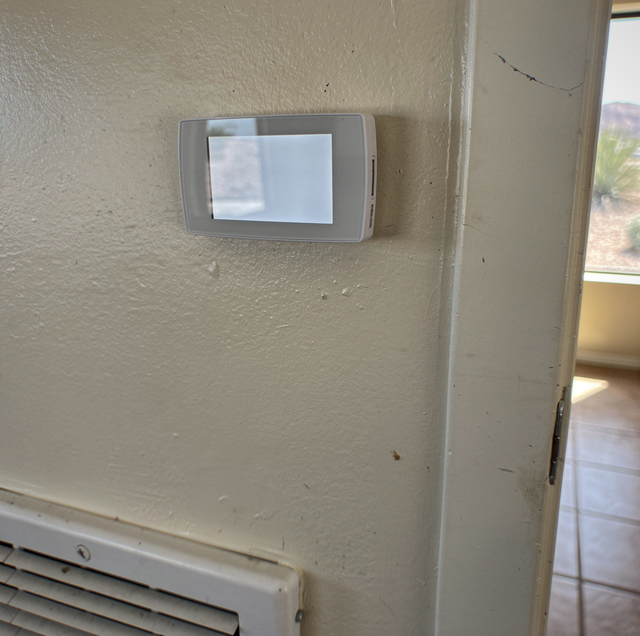
Every thermostat, whatever features it carries, does one job: it decides when your heating and cooling equipment turns on and off. A programmable thermostat and a smart thermostat both do that job by holding to a schedule instead of waiting for someone to adjust the dial, and the difference between them comes down to how that schedule gets set, how closely it tracks what is happening in the house, and what it takes to keep it running. Deciding which one saves more starts with understanding what each one does with that schedule.
The features that move a utility bill split the two designs like this:
| Feature | Programmable Thermostat | Smart Thermostat |
|---|---|---|
| How the schedule is set | Entered directly on the wall unit as a repeating daily or weekly program | Set once in a phone app and adjustable remotely afterward |
| Learning and occupancy features | None. It runs exactly the program you entered until you change it | On some models, the schedule adjusts from your own changes, or from motion and location sensing that judges whether anyone is home |
| Remote control | None. Changes require standing at the thermostat | Adjustable from an app wherever there is a connection |
| Usage reporting | None beyond the current setting shown on the display | On some models, runtime and cycling are logged and shown as a usage trend over time |
| Wiring needs (C-wire) | Can run on batteries or basic low-voltage wiring; on some models, a common wire is needed too | Needs steady power: a common wire, an adapter at the equipment, or, on some models, power drawn through the call wires |
| Compatibility with heat pumps and multi-stage systems | Available in heat-pump and multi-stage versions, matched to the equipment's stages and terminals | Wide compatibility is advertised, but still depends on the equipment type being configured correctly during setup |
| What savings depend on | Whether the programmed setbacks are followed and not overridden | The same setback discipline, plus whether the added features are configured and used |
Where Thermostat Savings Come From
The savings for either thermostat come from the same source: reduced total equipment runtime. A setback, easing off the setpoint for a stretch when nobody needs the tighter comfort band, means less time spent running. That is the entire mechanism, and the thermostat is only the tool that enforces it on a schedule rather than relying on memory.
The mechanism ties straight to how many hours the equipment already spends running. A mild winter paired with a summer cooling demand that climbs very high shifts most of that runtime into the cooling season, so a schedule's setbacks there have the longest stretch of hours to cut into. A colder climate puts that same heavy load on the heating side, so a heating setback gets hours of its own to cut into. Either way, the schedule nobody follows is the one that stops paying anything back.
What a Programmable Thermostat Does
A programmable thermostat runs on an internal clock and a set of stored temperature periods you enter directly at the wall unit. Programmable models let you build several periods a day, tied to a wake, leave, return, and sleep pattern, each set to its own temperature, and repeat that across a weekday block and a separate weekend block, or across all seven days if the setup is simpler. Once entered, the program runs on its own: the clock ticks forward, and at each period boundary the thermostat calls for whatever temperature that period holds.
The mechanism is entirely local. There is no connection to check and nothing running outside the box on the wall. That simplicity is also the limit: the schedule only reflects what someone told it when they built it, and it has no way of noticing that the household's pattern has shifted, a new work schedule, a stretch of vacation, a sick day home from school- until someone opens the program and edits it by hand.
What a Smart Thermostat Adds
A smart thermostat starts from the same setpoint-and-schedule idea, then layers on a network connection and, on some models, sensors that try to infer occupancy rather than assume it. Set up once through a phone app, the schedule can then be viewed and changed remotely, without anyone touching the wall unit itself. On some models, the schedule also adjusts based on the pattern of manual changes a household makes over time, which helps track the household's routine rather than running only what was typed in on day one.
One layer that touches the savings question directly is the usage report. Where a programmable thermostat shows only its current setting, a smart thermostat with reporting tracks how long the equipment ran and how it cycled, then presents that as a trend. That reporting does not reduce runtime on its own, but it turns an invisible number into something a household can see and respond to.
When the Features Don't Pay Back
A house with steady occupancy all day gets little benefit from occupancy sensing, since there is no absence for the feature to detect. A household that overrides the schedule constantly gets little benefit from either type of thermostat, since a setback that gets canceled every time it starts never has a chance to run. And a simple single-stage system paired with a small, well-insulated space may already have less runtime for a setback to trim, leaving added features with less to work with there.
None of that makes the added features pointless everywhere. A household with a real gap between occupied and empty hours, or one juggling multiple schedules across work and school, is exactly the situation those features were built to catch. What decides the payoff is whether the household's pattern gives those features anything to work with.
Wiring and Compatibility
Continuous power is where the practical limits show up. Smart thermostats need power around the clock to keep a screen lit and a radio connected, which is the job of a common wire, the C-wire, and a wall without one can still be wired to supply it.
Compatibility runs deeper than a yes-or-no sticker on the box. A heat pump or a multi-stage system has more terminals and more calls to manage than a standard single-stage furnace and air conditioner, and a thermostat has to be told, during setup, what kind of equipment it is running. Wired correctly but configured for the wrong equipment type, a thermostat can call for the wrong stage, fail to call a heat pump's backup heat when needed, or short-cycle a system that was built to ramp up gradually rather than switch hard on and off.
In a zoned home, each zone runs its own thermostat rather than a single unit controlling the whole house, so this comparison plays out one zone at a time rather than across the whole home at once.
Matching the Thermostat to the Equipment
The starting point for either type is the same: match the thermostat to the equipment before matching it to a feature list. That means checking the heating and cooling equipment's type and stage count against the thermostat's compatibility chart, confirming whether continuous power is available or needs to be added, and being honest about whether the household will open an app or would rather never think about the thermostat at all.
Before buying, check your furnace or air handler's model number against the thermostat's compatibility chart. Multi-stage and heat-pump systems may require a specific setting during setup, and skipping a setting is a reason a newly installed thermostat runs the system incorrectly.
The equipment side is what installation depends on. Swapping a thermostat that matches the existing wiring and equipment type is a simple, direct job. Anything past that- adding a common wire, configuring a multi-stage or heat-pump setup, or confirming a zoned system's separate thermostats are wired to the right zone- is technician work.
Cut power at the breaker before the old thermostat is removed from the wall, since a crossed pair of bare wires can blow the control board's fuse or damage the board. Thick wires on a baseboard or line-voltage thermostat are a technician's job.
Frequently Asked Questions
A battery-powered programmable rides through an outage untouched. A hardwired one can hold its clock on a small backup cell or capacitor; once that drains, the clock resets, and on models without non-volatile memory the stored program goes with it.
No. The schedule itself lives in the thermostat's own memory, not only in the cloud, so it keeps running its most recently saved program at the equipment. Losing the connection removes remote access and app control; it does not affect the programmed operation running at the wall.
On some models, geofencing waits a short time after you cross the boundary before switching modes, so a quick errand doesn't trigger a setback; on others, the lag depends on how often the phone reports its location, and the boundary radius is the setting you can adjust.
On models that offer both, a temporary hold keeps a manual change only until the next scheduled period starts, and then the program takes back over. A permanent hold keeps the new setpoint and suspends the schedule until someone cancels it, so a permanent hold left on by accident quietly stops every setback the schedule was built to make.
Following a schedule plainly means the temperature change starts at the scheduled time and drifts toward the new setpoint afterward. Adaptive or smart recovery starts the equipment early enough so that the target temperature is reached by the scheduled time, using the time elapsed in past cycles to estimate the required lead time. It is a timing feature, not a separate savings mechanism.
Not directly. The reports estimate usage from the equipment's runtime and cycling, not from a reading on the utility meter, so the number shown reflects a trend, not a measured saving. It is still useful for spotting a schedule that is not being followed, just not as a bill-accurate figure.
Ask about matching a thermostat to your equipment — the stages, wiring, and heat pump settings decide whether the schedule you pick can run. Modern Air Conditioning & Heating LLC serves Boulder City, Las Vegas, and Henderson. NV C-21 #0081442. Call (702) 919-4365.