
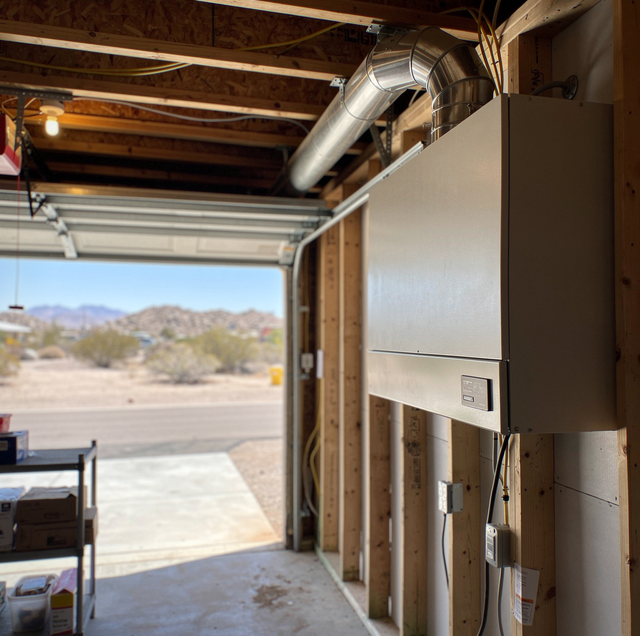
A garage loses heat in ways a living room does not. Its walls and ceiling can carry little or no insulation, its largest wall is a door that opens to outdoor air every time a car comes or goes, and it has no connection to the ducts that heat the rest of the house. That leaves three routes for a garage that needs heat of its own: a vented gas unit heater burning natural gas or propane, an electric unit heater wired on its own circuit, or a ductless mini-split heat pump that heats in winter and cools in summer. Each works through a different mechanism, and that mechanism determines the venting, wiring, and mounting.
Each factor lines up against the three routes as follows:
| Factor | Vented gas unit heater | Electric unit heater | Ductless mini-split heat pump |
|---|---|---|---|
| How it heats | Burns fuel and blows garage air across a heat exchanger | Passes current through a resistance element with a fan behind it | Moves heat from outdoor air to an indoor head through refrigerant |
| Fuel or power | Natural gas or propane | Electricity alone, on a dedicated circuit | Electricity for an outdoor unit and an indoor head |
| Venting | A flue to outdoors; sealed-combustion types add an intake pipe | None, since nothing burns | None; refrigerant tubing passes through the wall |
| Also cools | No | No | Yes |
| A garage used off and on | On single-stage units, full output once it fires, then cycles off at the setpoint | Full output while the element is on, then cycles off | Variable-speed models ramp down and hold a setpoint |
| Mounting and clearance | Hung from ceiling framing or high on a wall, clear of the door track, vehicle roofs and storage | Hung high on a bracket, clear of shelving and stored items | Indoor head high on a wall; outdoor unit on a pad or bracket outside |
| What installation involves | Gas piping, a vent run to outdoors and a structural mount | A new circuit from the panel and a structural mount | A wall penetration, refrigerant piping, a circuit and an outdoor location |
Why the House Ducts Stay Out of the Garage
A duct connection between the two spaces lets vehicle exhaust, fuel vapor, and solvent fumes travel into the living space whenever the pressure between them shifts, and a garage with an opening door and leaky walls keeps that pressure shifting. The three dedicated routes all keep the garage's air on its own side of the wall.
Gas Unit Heaters and How They Vent
A gas unit heater combines a burner, a heat exchanger, and a fan in a single cabinet. The burner heats the exchanger, the fan pushes garage air across it, and the combustion products leave through a flue. Where the unit takes its combustion air from and what moves its exhaust out separate the types.
Gravity-vented: The burner draws combustion air from the garage and relies on hot flue gas rising through a vertical flue to carry the exhaust away.
Power-vented: The burner still draws its air from the garage, and a fan drives the exhaust out through the vent pipe, so the vent can run sideways through a wall.
Sealed-combustion: A pipe brings in combustion air from outdoors, and a separate path carries the exhaust out, so the flame never draws on garage air.
That last difference carries weight in a garage but not in a mechanical closet. A garage holds gasoline, paint thinner, degreasers and cleaners, and a burner that pulls in garage air pulls their vapors through the flame with it. Some solvent vapors, particularly the chlorinated ones, break down in a flame into acidic compounds that can corrode a heat exchanger from the inside. Gasoline vapor is heavier than air and settles near the floor, which is why the height and location of a fuel-burning appliance in a garage are part of the choice along with its type. A sealed-combustion unit takes garage air out of the combustion path entirely, while a gravity or power-vented unit can suit a garage kept free of fuel and solvent storage.
Sawdust and grinding dust pulled into a burner can clog its ports. In a woodshop or metal shop, a sealed-combustion gas unit draws burner air from outdoors, though its fan still moves shop dust across the outside of the heat exchanger.
Whatever the type, combustion air must enter the volume the burner requires, because a burner starved of air burns incompletely and produces carbon monoxide. A carbon monoxide alarm sounding in the garage or the rooms beside it means everyone leaves the building, and the heater remains shut down until a technician finds the cause.
An unvented propane or kerosene heater burning in a closed garage releases carbon monoxide and combustion moisture straight into the air people breathe. A vented unit, with its gas piping and flue installed by a licensed contractor, carries that exhaust outdoors.
A gas smell in the garage means leaving the building and calling the gas utility from outside, without touching light switches, the door opener, or the heater's controls on the way. The gas and vent connections themselves are licensed work, and the permit for them is issued by the local building authority.
Electric Unit Heaters on Their Own Circuit
An electric unit heater converts electrical current into heat via a resistance element and blows the garage air across it with a fan. Every watt it draws ends up as heat in the garage, and there is no flame, no flue, and no combustion air to plan for, so fuel vapor and solvent fumes never pass through a burner. A glowing element can still ignite fuel or solvent vapor that reaches it, so an electric unit should stay clear of fuel cans, paint, and stored items as well. On the ventilation side, the electric route asks nothing of the building.
The demand moves to the wiring instead. A hardwired unit heater sized for a garage draws a heavy, continuous load, beyond what a shared outlet circuit is meant to carry, so it runs on a dedicated circuit from the panel, and adding that circuit is electrician work under a local permit.
A Mini-Split Heat Pump for a Garage That Is Also Cooled
A ductless mini-split pairs an outdoor unit with an indoor head mounted high on a garage wall, joined by refrigerant tubing and a control cable that pass through the wall between them. In heating mode, the refrigeration cycle runs in reverse, gathering heat from outdoor air and releasing it through the indoor head, and its output falls as the outdoor air turns colder. It is one of the three that also cools, so it earns its place in a garage that has to be usable in both seasons: a workshop, a home gym, or a hobby space someone works in year-round.
The heat pump is also the route with an outdoor unit to site. That unit needs a pad or wall bracket with open air around it; the tubing needs a path from there to the indoor head, and the refrigerant connections are work for a certified technician. Where a garage has been converted into a finished room that shares the house's cooling, choosing between a mini-split and a duct extension is a separate decision about that room.
Matching the Heater to How the Garage Gets Used
A garage heated for a weekend project and a garage held at one temperature all week ask different things of a heater. Single-stage gas and electric unit heaters run at their full rating whenever they are on and switch off at the thermostat's setpoint, so they bring a cold space up and then cycle, a pattern that suits a garage switched on for a project and off again afterward. A variable-speed mini-split slows its compressor as the space nears the setpoint and holds it there, a pattern that suits a garage occupied or kept conditioned for long stretches.
Neither pattern locks a route out. A unit heater can keep a garage warm all day, and a mini-split can be switched on for a single evening. What changes is how each one spends its energy getting there, which depends on how much heat the building lets out.
How Insulation and the Door Decide the Size
Heat leaves a garage through four surfaces: the walls, the ceiling, the door and the slab. An uninsulated wall or ceiling passes heat outward the whole time the heater runs, and an insulated one slows that loss.
The door carries two separate losses. A thin metal door with no insulating core conducts heat straight through its panels, and gaps at the bottom seal and along the jambs let cold air in around it. Each time the door rolls up, the heated air near it spills out, and the heater has to warm the outdoor air from the start. The concrete slab draws heat downward as well, and it stays cold after the air above it has warmed.
Those losses are why a heater sized solely by floor area can miss in either direction. An insulated garage with a sealed, insulated door and a heater sized for a bare shell reaches the setpoint in short bursts and cycles on and off; an uninsulated garage with a heater sized as though it were insulated runs without catching up. A heat-load calculation brings the walls, ceiling, door, and air leakage into the figure. Insulating the ceiling or fitting an insulated door before the heater is chosen changes that figure, so the heater is sized to the garage as it will stand afterward.
Frequently Asked Questions
No. A gas unit heater depends on electricity for its fan, ignition, and controls, and power-vented and sealed-combustion types also need it for the vent fan, so the burner shuts down with the power and restarts once power returns.
Through a vent that opens onto an exterior wall or above the roof, depending on the heater type and the building. The termination is placed away from windows, doors and the garage door opening, so exhaust leaving the vent does not drift back into the garage or the house.
A thermal cutout inside the heater. If the fan stops or something blocks the airflow across the element, the cutout senses the rising temperature and cuts power to the element. A heater that keeps tripping it has a fan or airflow fault to find.
Yes. When the indoor head cools, moisture condenses on its coil and must leave through a condensate line, routed by gravity to the outside or lifted by a small condensate pump when the head sits below a workable drain path.
Only if it has room for the added load. Gas piping is sized for the combined input of all appliances it serves and the length of the run from the meter, so adding a heater may require a larger pipe or a separate line from the meter.
The burner, the heat exchanger, the fan and its motor, and the vent. The vent and any intake terminal are also checked for nests, leaves, and debris, since a blocked terminal prevents exhaust from leaving or combustion air from entering.
Contract garage heater installation — heat-load sizing for the garage as built, a mount clear of the door track and stored fuel, and the vent or circuit each route needs. Modern Air Conditioning & Heating LLC serves Boulder City, Las Vegas, and Henderson. NV C-21 #0081442. Call (702) 919-4365.