
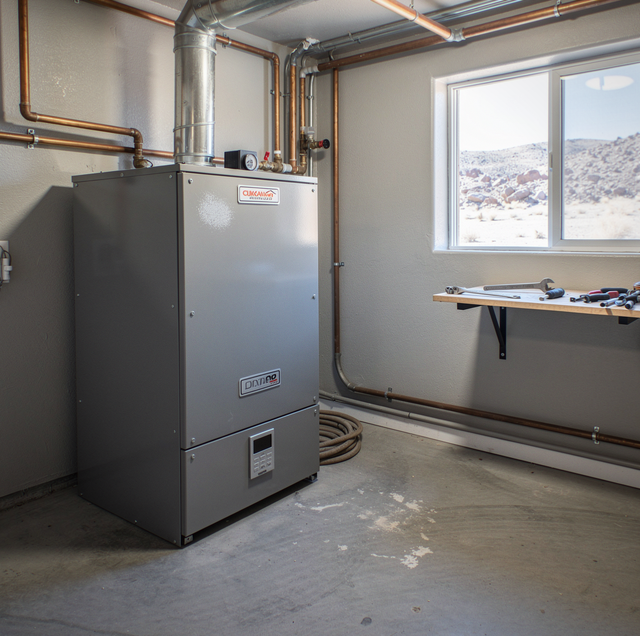
A hydronic system is a loop of components, and the boiler is only one of them. It heats water, a circulator moves that water through the near-boiler piping, and the radiators or baseboard in your rooms give the heat up to the air before it returns for another pass.
When one part of that loop starts failing, the question that lands on you is rarely about that one part alone. Your boiler carries the nameplate and the efficiency rating. Your emitters carry no rating at all, and they still limit what any rating can produce for you.
So your decision depends on inputs you can establish: the plant's age, what your recent failures have in common, what your emitters accept, and what an inspection finds.
What Age Places a Boiler Under an Older Efficiency Rule?
Age on a boiler is a date stamp before anything else, and it establishes which federal standard the plant was built under. A federal efficiency rule for residential boilers, finalized in January 2016, sets an 84 AFUE minimum for gas-fired hot water boilers, effective from January 15, 2021.
That same rule carries a design requirement alongside the number: a constant-burning pilot is not permitted on equipment built to that standard. A standing pilot in a basement is an age marker in its own right, and the old advice about relighting one has no place on modern equipment. The pilot, the gas valve and the gas line are a technician's work in any case.
None of that makes a pre-2021 boiler a replacement candidate on its own. Cast-iron sectional boilers routinely run thirty years and more, and a well-kept one with a sound heat exchanger is a serviceable machine at that age. What age gives you is the efficiency band the plant was allowed to sit in, and the blog's HVAC jargon guide covers the term if you want it first.
The Difference Between Small Repairs and One Failing Section
Three service calls in two heating seasons mean different things depending on what they were for. A circulator, an ignition module, a zone valve, and an expansion tank are wear items in a hydronic system, and replacing them in sequence is ordinary maintenance for a machine whose pressure vessel is still sound. Those parts sit outside the water jacket and come off without disturbing it.
The pattern that changes the conversation is repair work that keeps returning to the water side: a section weeping at a push nipple, a heat exchanger starting to seep, make-up water feeding in between calls to hold pressure. A boiler you have to feed to stay in its pressure band is losing water somewhere, and on a cast-iron block the leak is usually the block.
Your Radiators and Baseboard Limit the Return Water Temperature
A condensing boiler earns its rating by extracting latent heat from the flue gas, which occurs only when water returning from your loop is cool enough to condense. On the reset curve for a condensing boiler, the return water should stay below 130 degrees Fahrenheit, which keeps return temperatures low enough to promote condensing and meaningfully raises the system's energy efficiency.
Reaching that will likely mean dropping the supply temperature below the factory setting, and it puts the burden on the emitters: the heat emitters used, baseboard or radiators alike, have to be sized to the average temperature of the distribution loop, because undersized emitters cannot release enough heat to the space, so the water returns to the boiler too hot to condense. Baseboard laid out for 180-degree water is undersized for 140-degree water.
So a 95 AFUE unit dropped onto emitters that need high supply water to hold the rooms runs above its condensing range and behaves like the boiler it replaced. The rating on the jacket describes the appliance, not the loop it was installed into. An installer who measures the emitter surface in each of your rooms against its own heat loss is checking whether that rating can actually arrive at design conditions; one who only copies the old nameplate is not.
Non-modulating boilers run at 85 to 90 percent efficiency, and fully modulating condensing boilers with advanced controls run at 92 to 96 percent. Only a loop that returns cool enough water delivers that difference.
The Combustion Findings That End the Conversation Early
Some findings end the efficiency argument entirely. A cracked section, a failed heat exchanger, or a flue that no longer draws can push combustion products into your house instead of up the vent, and carbon monoxide has no color or smell. A technician establishes this with instruments: a combustion analyzer in the flue, a draft measurement at the vent connector, and a visual pass over the sections.
A finding on that side is a stop. Equipment with a combustion or venting defect is taken out of service until the defect is corrected, and no efficiency comparison is made while it is out. It is why a repair-or-replace visit on a gas-fired plant starts at the combustion side and works outward, instead of starting with the model number, and why you get the safety picture before the arithmetic.
If a carbon monoxide alarm sounds or anyone feels headache, nausea or dizziness while the boiler is firing, leave the building and call the gas utility or 911 from outside rather than going back in.
A Replacement Changes the Venting and the Condensate Path
Swapping your boiler is rarely a swap. An atmospheric cast-iron unit vents into a masonry chimney or a B-vent by natural draft, and the flue gas leaves hot enough to keep your liner dry. A condensing unit does the reverse. It leaves so little heat in the exhaust that the gas condenses, so it vents through sealed pipe listed for the service, usually polypropylene or stainless, run to a sidewall or up through the roof with its own combustion air intake. Your old chimney is then carrying nothing from the boiler, and a natural-draft water heater still connected to it has been orphaned on a flue sized for two appliances and now warmed by one.
The condensate is the second change. A condensing boiler makes several gallons of acidic water a day when it runs hard, and it needs a drain, a neutralizer, and a frost-free route.
The near-boiler piping changes too. A modern heat exchanger has narrow water passages that require a specific flow rate, so these units are commonly piped as primary and secondary, with a dedicated pump and a low-loss header, whereas your old cast-iron block sat on a single main. Add gas sizing for a modulating burner and the control wiring, and what you are replacing has moved well past the boiler you started with.
Whether the Parts Still Exist for Your Plant
Parts availability ends more of these conversations than efficiency does. A sectional boiler remains repairable as long as the sections, push nipples, and their gaskets are still cast, and a control board, gas valve, or Aquastat remains replaceable as long as someone builds one or a listed equivalent exists. Obsolescence arrives one component at a time, rarely the one you expect.
When the part is obsolete, a repair turns open-ended. A salvaged control from a decommissioned unit carries no warranty or promise that you have the same revision, and a boiler waiting weeks for a part is not heating your house. The model and series numbers, and whether the failed component is still supported, are worth having before you agree to a repair.
What a New Control Cannot Do on an Old Loop
That same federal rule includes one more requirement for gas-fired hot water boilers: an automatic means of adjusting water temperature is required, except for boilers equipped with tankless domestic water heating coils. So the control that would hold your return temperature down arrives with the unit.
On emitters that need high supply water, that control gets turned up until the rooms hold, and a unit you chose for 95 percent spends one heating season after another above its condensing range. The control ships in the box; the loop overrules it.
Frequently Asked Questions
A low-water cutoff shuts the burner down when the water level in your boiler drops, preventing the heat exchanger from firing dry. Many older units never carried one. If yours is repaired anyway, ask your technician whether the plant has a working cutoff and whether you should add one.
Pressure between calls indicates you are losing water from the loop. The candidates are an expansion tank that has lost its charge, a discharging relief valve, a weeping section, and leaks at the vents. Your fill valve hides it by feeding make-up water, which is why a system that holds pressure while your water meter creeps is worth a look. Note the gauge over a few days and give that to your technician before you agree to anything.
A room-by-room heat loss calculation at your design temperature, set against the output of your baseboard or radiator surface in each room, is the method. Output tables in BTU per hour per linear foot at 180, 160, and 140 degrees show the drop between those columns, and that drop is how much more surface you would need before you could run cooler water.
Not as your boiler's vent. A condensing unit produces wet exhaust that a masonry flue cannot carry without damage, so yours vents through listed plastic or stainless pipe. What you are left with is a chimney without the boiler's heat, and any appliance still using it needs your installer to size a liner for it alone.
Usually a system problem. A relief valve opens when pressure exceeds its setting, and the causes are upstream of it: an expansion tank that has lost its air charge, a fill valve feeding at a higher pressure than your set point, or an aquastat that lets the water run too hot. The valve itself is your last suspect, and because it discharges scalding water, you leave lifting or testing that lever to your technician.
No. That same 2016 federal rule lists steam as its own product class with its own figure: a gas-fired steam boiler is held to 82 AFUE, two points under the hot-water line, with only the constant-burning pilot ban. The automatic water-temperature requirement that applies to hot-water units is absent from the steam row, because a steam system has no circulating water temperature to reset. So if your plant is steam, you are being measured against a different line in the same table, and none of the return-temperature argument above applies to your system. The product class your new unit is certified under is the one to ask about.
A boiler that has started failing in a pattern deserves a combustion check and an emitter survey in a single visit — the efficiency number on any replacement is then measured against the water temperature your own radiators actually need, before anything gets ordered, vented, or torn out. Modern Air Conditioning & Heating LLC serves Boulder City, Las Vegas, and Henderson. NV C-21 #0081442. Call (702) 919-4365.
