
What a Thermostat C-Wire Is and Why It Matters
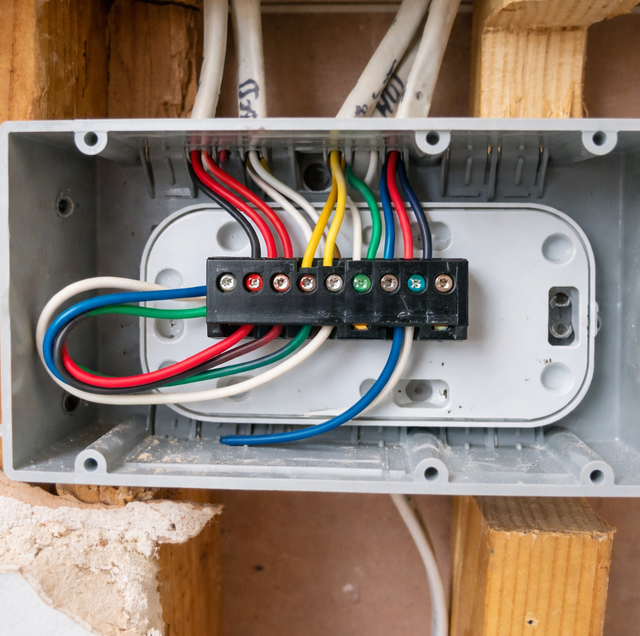
If your new smart thermostat keeps rebooting, losing its Wi-Fi connection, or throwing a low-power warning, the cause often traces back to a single wire that was never part of the older thermostats it replaced. That wire is the C-wire, short for common wire, and it is the reason many upgrades run flawlessly while others fight for power from the day they go on the wall.
Understanding what the C-wire actually does, before you start hunting for adapters or running new cable, saves a lot of guesswork. It also helps you tell the difference between a thermostat that is truly misbehaving and one that is starved for steady voltage.
Quick Answer: The C-wire is the "common" wire that completes a continuous 24-volt low-voltage circuit so a thermostat has constant power. Older thermostats ran on batteries or borrowed power in short bursts, so they never needed it. Smart and Wi-Fi models keep a screen and radio running around the clock, so they do. If the C terminal on your thermostat is empty, you have options, but power should be cut at the breaker before anyone inspects the wiring.
The Low-Voltage Wiring Behind Your Thermostat
A thermostat does not switch the high-voltage power that runs your furnace or air handler directly. Instead, it works on a separate low-voltage control circuit, usually 24 volts, produced by a small step-down power unit inside the equipment. When the thermostat calls for heating or cooling, it closes a low-voltage circuit that tells a relay or control board to start the real work.
That control circuit is carried on a bundle of thin wires, each landing on a lettered terminal. The common set looks like this:
R: the power (red) wire: R delivers the 24-volt hot side from the low-voltage power unit. Some systems split this into Rc for cooling and Rh for heating, joined by a jumper when a single unit feeds both.
W: the heat call (white) wire: W energizes the heating circuit. When the thermostat wants heat, it connects R to W, and the furnace or air handler responds.
Y: the cooling call (yellow) wire: Y triggers the compressor and outdoor condenser for air conditioning. It closes the same way W does, just on the cooling side.
G: the fan (green) wire: G runs the indoor blower fan on its own, which is what happens when you set the fan to "on" without a heat or cool call.
C: the common (blue, usually) wire: C is the return leg of the 24-volt circuit. It gives the thermostat a continuous path back to the low-voltage power unit, which means power can flow through the thermostat itself at all times, not only during a heating or cooling call.
The first four terminals switch things on and off. The C terminal is different because it does not command anything. It simply keeps the loop closed so the thermostat can draw a steady trickle of power for its own electronics.
Why Older Thermostats Skipped the C-Wire
A basic mechanical or early digital thermostat needs almost no power of its own. A mercury-bulb model used none at all, and a simple digital one ran its clock and display off two AA batteries for a year. Because those thermostats only closed a circuit when they called for heating or cooling, the wall never needed a full-time power path, so builders and installers frequently left the C-wire out of the cable run, or coiled it unused inside the wall.
That worked fine for decades. The trouble starts when a device that expects constant power gets mounted on wiring designed for a device that did not.
Why a Smart Thermostat Needs Constant Power
A Wi-Fi thermostat is a small always-on computer. It keeps a color screen lit or in standby, holds a wireless radio connected to your router, logs usage, and sometimes runs sensors and voice features. None of that pauses when the heating or air conditioning is off, so the thermostat needs power around the clock rather than only during a call.
With a C-wire present, that power arrives cleanly through the completed 24-volt loop. Heating and cooling both rely on the same low-voltage control system, so a proper C-wire connection supports the thermostat year-round, in any season, whether the equipment is running the furnace or the compressor.
Without a C-wire, some smart thermostats fall back on a technique called power stealing. The thermostat borrows tiny amounts of current through the heating or cooling call wires without fully triggering the equipment. It is a clever workaround, but it lives on a knife's edge. Draw too little and the thermostat browns out; draw too much and it can make a furnace relay chatter or a system short-cycle.
Power stealing is a lot like trying to keep your phone charged by unplugging it every few minutes to run something else off the same outlet. It might hold a charge on a light day, but under load it leaves you flickering between just enough and not enough.
What a missing C-wire looks like in practice: When a smart thermostat is scavenging power instead of receiving it steadily, the symptoms are recognizable:
- The screen reboots or restarts on its own, often several times a day.
- Wi-Fi drops and the thermostat disappears from its app, then reappears later.
- A low-battery or low-power warning shows up even on a hardwired model.
- The heating or cooling flickers on and off in short bursts, called short-cycling.
- The display dims or goes dark when the system cycles.
Any one of these can have another cause, but together they point strongly toward a power-delivery problem rather than a defective thermostat.
How to Check Whether You Already Have a C-Wire
Many homes have a C-wire already run and simply capped or tucked behind the thermostat, unused by the old unit. Finding out is a short inspection, but power comes first.
Cut the power before you touch anything. Switch off the breaker for the furnace or air handler, or flip the service switch on the equipment itself. Low-voltage wiring can still be live even when the thermostat looks dead, and a slip that shorts two terminals can damage the control board or the thermostat.
With power off, gently pull the thermostat face off its wall plate. Look at the terminal block and check two things. First, is any wire landed on the terminal marked C? Second, are there extra wires pushed back into the wall opening that are not connected to anything? A spare wire, often blue, coiled and unused, is frequently a C-wire that was run but never terminated.
Many homes already have a C-wire run and simply capped behind the thermostat. With the face off, look for an extra wire, often blue, coiled and unused in the wall opening, since that spare can usually be put to work as the common connection.
If a wire already sits on the C terminal, your thermostat has its common connection and the power problem lies elsewhere. If the C terminal is empty but a spare wire waits in the wall, that spare can usually be put to work. If there is no extra wire at all, you move to the options below.
Your Options When There Is No C-Wire
A missing C-wire is a solvable problem, and there is more than one path depending on what the wall gives you.
Use an existing unused wire: If the cable behind the thermostat has a spare conductor, a technician can connect it to the C terminal at the thermostat and to the common tap on the equipment's control board. This is the cleanest fix because it uses real, dedicated wiring end to end.
Add a power module or C-wire adapter: When no spare wire exists, an add-a-wire module or power-extender kit can create a common path over the wires you already have. These devices install at the furnace or air handler and let the existing conductors carry both the control signals and steady power to the thermostat. Some thermostat brands include their own adapter in the box. The catch is that these modules must be matched to the system and wired correctly, or they can misbehave.
Run a new wire: The most durable answer is a new thermostat cable with enough conductors, typically an 18-gauge multi-conductor bundle, pulled from the equipment to the thermostat. When the wall cavity allows it, this gives every terminal a true home and leaves spare conductors for future upgrades.
Why Some Systems Are Different
Not every setup follows the R-W-Y-G-C pattern. Heat-only systems may have no Y wire at all because there is no compressor to command. Some boiler and hydronic setups, along with certain heat pumps, use different terminal labels such as O/B for the reversing valve, and their common connection can sit in a different place than a standard forced-air furnace.
Line-voltage thermostats are a separate world entirely. Electric baseboard and some older heating units switch 120 or 240 volts directly at the thermostat, with no low-voltage step-down unit and no C-wire concept.
A smart thermostat built for 24-volt control must never be wired to a line-voltage circuit. If the wires at your thermostat are thick and marked with high-voltage ratings, meaning the unit switches 120 or 240 volts directly, stop and call a professional before going further.
Why a Pro Should Verify the Setup
Confirming a C-wire is easy to describe and easy to get wrong. The common tap has to land on the correct point at the equipment, the low-voltage power unit has to have the capacity to feed a constantly powered thermostat, and any adapter has to match the specific system. Miswiring a single terminal can damage a control board, a power unit, or the thermostat, and a battery-only patch forced onto a system that truly needs steady power just trades one set of failures for another.
An HVAC technician can trace the existing wiring, verify compatibility, install the right common source, and confirm the thermostat holds steady power through both heating and cooling cycles before leaving. That verification is what turns an upgrade that fights for power into one that simply works.
Frequently Asked Questions
Some do, but it means giving up independent fan control, since the G terminal then serves as the common path and can no longer run the blower on its own. It also only works if your thermostat does not need the G wire for its own features. A dedicated common conductor or a proper power module is the safer route, because repurposing G can leave you unable to run the fan without a heating or cooling call.
The 24-volt control circuit is alternating current straight off the equipment's low-voltage supply, not direct current. The thermostat's own electronics convert that 24-volt AC down to the low-voltage DC its board and radio actually use. This is why the supply's rating matters: an undersized or aging unit may not deliver enough steady current for a power-hungry smart model even when a C-wire is present.
Sometimes, through power stealing or an internal rechargeable cell, but "works" and "works reliably" are different things. A thermostat leaning on borrowed power may run for weeks, then start rebooting once the router signal weakens or the system cycles more often. Manufacturers increasingly list a C-wire as recommended rather than optional for exactly this reason.
Standard low-voltage thermostat cable is 18-gauge, and it comes in bundles of varying conductor counts, often labeled as 18/5, 18/7, or 18/8. The number after the slash is how many individual wires are inside. A five-conductor run covers R, W, Y, G, and C for a common forced-air system, and pulling an eight-conductor cable leaves spares for heat pumps or future accessories.
Yes, so color alone is not proof. A spare conductor might be a second-stage heat or cool wire, a heat-pump reversing-valve wire, or simply an unused strand. This is why identifying it by tracing where it lands at the equipment matters more than trusting the color, and why a misidentified wire connected as common can trip a breaker or damage the board.
The C-wire itself draws only the small, steady trickle the thermostat needs, which is negligible on a utility bill. The larger effect is indirect: a reliably powered smart thermostat can hold schedules, geofencing, and setback routines without dropping offline, and those features are where any real efficiency gains come from. A thermostat that keeps rebooting cannot run the programming that saves energy in the first place.
Book a thermostat and control-wiring check — get your smart thermostat wired for steady, reliable power. Modern Air Conditioning & Heating serves Boulder City, Las Vegas, and Henderson. NV C-21 #0081442. Call (702) 919-4365.
