
Repair or Replace? How to Decide on an Aging Air Conditioner
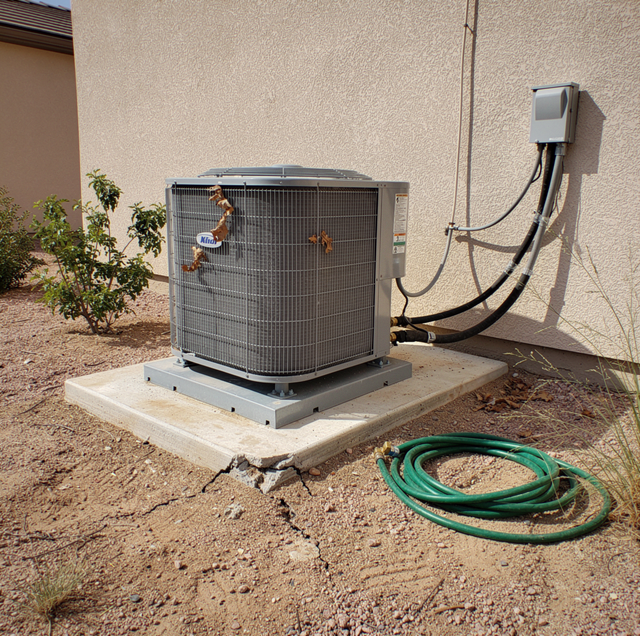
Deciding whether to repair or replace an aging air conditioner rarely comes down to a single clear signal. It's usually a handful of smaller clues- age, repair history, efficiency, refrigerant type- that add up to an answer once you look at them together.
When a Repair Call Turns Into a Bigger Decision
Once a cooling system passes the ten-year mark, almost every breakdown comes with the same question attached: is this worth fixing, or is it time to plan for something new? A single failed capacitor doesn't tell you much on its own. But when it's the second or third repair call in two summers, and the unit has been running nearly nonstop through months of triple-digit afternoons, the question deserves a real answer rather than a guess.
Extended near-continuous runtime is hard on a compressor and its supporting electrical components. The compressor draws a heavy inrush of current every time it starts, and the run and start capacitors that support that startup wear down faster the hotter and longer they operate. A system asked to cycle constantly for months at a stretch logs far more of those stressful starts than one that only runs a few weeks a year. That's why age alone isn't the whole story, and why the decision benefits from a few more data points than "how old is it."
This guide walks through the factors that actually separate a repair-worthy system from one that's better replaced: age relative to its expected service life, the pattern of recent repairs, how much efficiency you're losing to wear, and the refrigerant the system runs on.
What Age Alone Doesn't Tell You
A well-maintained central air conditioner typically lasts 12- 17 years before major components start failing in earnest, though that window shrinks for systems that run long hours during extended hot seasons. It's less about the calendar and more about accumulated run hours: a compressor that's logged 14 summers of near-daily operation has done more work than one that's coasted through 14 mild ones.
Inside that aging compressor, bearings wear, motor windings lose insulation integrity, and the internal valves that manage refrigerant flow lose precision over time. None of that shows up as a single dramatic failure most of the time. It shows up as longer run cycles to hit the same setpoint, a compressor that sounds louder or strains on startup, or a capacitor that needs replacing a year after the last one again. Contactors, the electrical switches that engage the compressor and outdoor fan, also pit and corrode with repeated cycling, which can cause a unit to hum but not start, or start and immediately trip off.
If your system's nameplate shows a manufacture date well into its second decade, and especially if it's been running long hours through extended cooling seasons, age is already working against it even before you factor in what's actually broken.
The Pattern Behind Recent Repairs
One repair call doesn't mean much by itself. A capacitor failing at year eight is a normal, low-stakes fix. What matters is the pattern across the last year or two of service calls.
Look at whether the failures are spreading. A capacitor this year, a contactor last year, and a refrigerant leak the year before are three different parts of the system breaking down, which points to overall wear rather than one bad component. Compare that to a single part failing more than once in a short window, which sometimes points to an installation issue, an electrical supply problem, or a mismatched replacement part rather than the system itself aging out.
Also weigh how the unit performs between repairs. A system that returns to full, even cooling after each fix behaves differently from one that never quite gets back to how it ran a couple of years ago. Diminishing performance between repair visits is often a clearer signal than the repair count itself.
Where Efficiency Quietly Gets Lost
A successful repair restores a broken part to working order. It does not change the efficiency rating the system was built to. If your outdoor unit has a SEER rating well below current SEER2 minimums, it will draw more power to produce the same cooling output than a new system would, no matter how well the last repair was done.
SEER2 is the updated efficiency testing standard that took effect in 2023, and it measures performance under conditions closer to how a system actually operates once it's connected to real ductwork, rather than under a more forgiving lab setup. Systems rated under the older standard aren't automatically bad, but many older units, especially ones original to the home, were built to efficiency levels well below what's now standard.
Two other factors quietly erode efficiency over the years and aren't always fixed by a routine repair. Windblown dust packs into the fins of an outdoor condenser coil, restricting the airflow the system needs to reject heat, and while a cleaning helps, coils that have been caked for years can lose some of their original heat-transfer capacity for good. Indoors, hard water scale can build up on an evaporator coil and inside the condensate drain line, insulating the coil from the airflow passing over it and slowing drainage. A tune-up addresses some of this, but a coil that's scaled or corroded from years of mineral buildup won't perform like a clean, new one again.
What the Refrigerant on the Nameplate Tells You
The refrigerant your system runs on affects both how easily it can be serviced now and how it will be viewed by future service technicians. Older systems built before roughly 2010 often ran on R-22. The U.S. stopped allowing new R-22 equipment to be manufactured or imported starting January 1, 2010, and production of the refrigerant itself was phased out domestically by 2020. What's available today comes only from reclaimed and recycled supplies, which are limited and becoming harder to source. If your outdoor unit's data plate lists R-22, a refrigerant leak repair alone can become a bigger project than the leak itself.
Even R-410A, the refrigerant that replaced R-22 in most residential systems, is now being phased down under a federal schedule that limits how much manufacturers can produce each year. Newer equipment is shifting to lower-impact refrigerants such as R-454B. That doesn't mean an R-410A system needs to be replaced early, but the refrigerant type printed on the nameplate is one more piece of the age puzzle, not just a technical detail.
Repair or Replace: A Side-by-Side Comparison
Weigh these factors together rather than any single one in isolation. A system can lean toward replacement on age but still be worth repairing if the rest of the picture looks solid, and the reverse is also true.
| Factor | Leans Toward Repair | Leans Toward Replacement |
|---|---|---|
| Age of the system | Under about 10 years old | Well into its second decade, nearing or beyond typical service life |
| Repair pattern | First or occasional issue with a clear, isolated cause | Recurring breakdowns across different components each season |
| Performance between repairs | Returns to full, even cooling after each fix | Never quite returns to prior performance; cooling lapses widen |
| Refrigerant type | Runs on a refrigerant still in active production | Runs on R-22 or another refrigerant with limited remaining supply |
| Efficiency rating | SEER2 rating reasonably close to current standards | Rated well below current SEER2 minimums |
| Coil and drain condition | Coils clean or lightly fouled; condensate drains freely | Coils scaled or corroded; drain line chronically clogging |
| Compressor condition | Compressor tests healthy; the failed part is elsewhere | Compressor itself is failing or has already been replaced once |
| Sizing and ductwork fit | System was properly sized, and ducts are in good shape | Original sizing or ductwork was never quite right for the home |
Cases Where Repair Is Still the Right Call
None of this means every aging system should be replaced. A unit under roughly a decade old with a single, unrelated component failure, a capacitor, a run contactor, a blower motor, is usually still a good repair candidate, especially if its efficiency rating isn't far off current standards and the coils have been kept reasonably clean. Systems that have had consistent maintenance tend to hold their performance longer than ones that haven't had a filter changed or a coil cleaned in years, so a maintenance history matters as much as a birth date.
If the compressor itself tests healthy and the rest of the system, ductwork, sizing, coil condition, is in reasonable shape, a repair gets you back to full function without giving up years of remaining service life. The math shifts once the compressor is the failing part, since it's the most labor-intensive component and the least likely to be worth repairing on an older system.
What to Check Before Making the Call
Before your next service call, it helps to have a few answers ready. Check the nameplate on the outdoor unit for the manufacture date, and note the refrigerant type printed there as well. Count how many service calls the system has needed in the last two cooling seasons and whether those repairs involved the same part twice or different parts each time. Think about how the system has performed on the hottest days this year compared to a year or two ago, since a gradual decline often shows up before an outright failure does.
If replacement turns out to be the better path, a proper heat-load calculation, not just matching the old unit's size, should guide what capacity goes in next. An oversized replacement short-cycles and struggles with humidity even though it's brand new, which undercuts a lot of the benefit of upgrading in the first place. It's also worth having the ductwork checked at the same time, since leaky or undersized ducts can limit even a well-matched new system's performance.
Frequently Asked Questions
Most residential swaps of the outdoor condenser and indoor coil are completed in a single day, though a system that also needs new ductwork, a line set replacement, or electrical upgrades to support a larger unit can run longer. Timing shouldn't come at the expense of accuracy: a unit sized only to match the old system's tonnage ignores any insulation, window, or other envelope changes made to the home since the original installation, which can leave the new equipment mismatched to the load it's actually working against.
It's possible, but mismatched components rarely perform as well as a matched system, and pairing a new condenser with an old coil designed for a different refrigerant or capacity can shorten the life of the new equipment and sometimes void the manufacturer's warranty. Most installers pair the coil and condenser together for that reason.
It can, but home warranty contracts often cap payouts or exclude coverage for equipment that wasn't maintained regularly, and many won't cover a full system replacement even when they cover component repairs. Reading the exclusions is worth doing before assuming a warranty settles the decision for you.
Refrigerant leaks usually start as pinhole openings in copper line sets or coil joints caused by vibration, corrosion, or a manufacturing flaw, and they leak slowly rather than all at once. That slow loss shows up first as reduced cooling capacity on the hottest days, well before the system stops working entirely, which is why a unit can seem to be "just getting weaker" for a season or two before a repair call gets triggered.
Yes, and a replacement estimate is the point at which a technician can actually check the duct condition instead of just guessing. That usually means a static pressure reading at the air handler to see whether the ducts are restricting airflow, plus a look at accessible runs for crushed sections, gaps, or disconnected joints. Skip that step and the new equipment gets installed around the same duct problems that were limiting the old system, so a homeowner ends up paying for new equipment while still living with rooms that run warm or a system that short-cycles trying to compensate.
A heat pump replacement swaps out equipment that handles both heating and cooling through the same outdoor unit, compressor, and reversing valve, so sizing has to account for the home's heating load in the coldest months as well as its cooling load in the hottest ones, not just one side of the equation. An AC-only replacement skips that step entirely, since it's sized around summer cooling load with the home's furnace or other heat source left untouched. Heat pump replacements also call for a closer look at cold-weather output, since a model that's undersized for the local climate can lean too heavily on backup heat strips during cold snaps, driving up electric bills in a way that never comes up when the equipment being replaced only ever ran in cooling mode.
Get a professional opinion on your aging AC — a technician can check the compressor, refrigerant type, and efficiency rating to tell you honestly whether repair or replacement makes more sense. Modern Air Conditioning & Heating LLC serves Boulder City, Las Vegas, and Henderson. NV C-21 #0081442. Call (702) 919-4365.
