
Why Is Water Leaking From My Indoor AC Unit? 8 Causes to Check
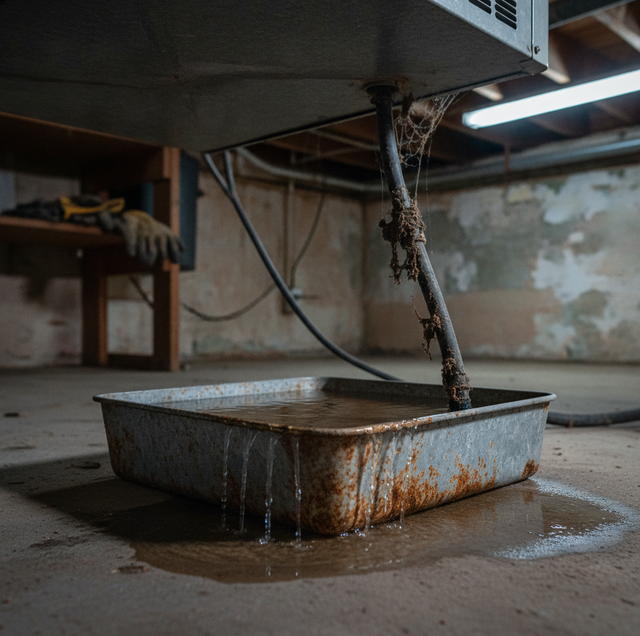
Quick Answer: A leaking indoor AC unit usually means the condensate drain line is clogged and water is backing up over the drain pan. Other common causes are a cracked or rusted pan, a frozen coil that melts all at once, a failed condensate pump, or a disconnected drain line. Turn the system off first to stop it from adding water, then check the air filter and drain line.
Water dripping from the indoor part of your air conditioner almost always means the same thing: condensation that should be draining away has nowhere to go. Before you assume the worst, it helps to understand that your indoor unit is supposed to make water. The trouble starts when that water stops leaving the way it is designed to.
This guide walks through what the water actually is, the eight most common reasons it ends up on your floor or ceiling instead of down the drain, and the specific signs that point to each cause. It also covers what you can safely do right now and where the line sits between a quick fix and a call to a licensed HVAC tech.
Where the Water Comes From in the First Place
Your indoor unit, whether it sits in a closet, an attic, or a garage, holds the evaporator coil. As warm, humid indoor air passes over that cold coil, moisture condenses on the fins the same way beads of water form on a cold glass of iced tea on a hot day. That is the one analogy worth keeping in mind: the coil sweats, and all that sweat has to go somewhere.
By design, the condensation drips off the coil into a sloped drain pan directly underneath, then flows out through a small PVC condensate drain line that carries it outside or to a floor drain. When everything works, you never see a drop. When you find water pooling under the air handler, staining the ceiling, or dripping from a closet, it means that the drainage path has failed somewhere along the line. Finding the leak is mostly a matter of tracing that path from the coil to the outside and looking for the break.
The Eight Usual Suspects
A Clogged Condensate Drain Line
This is the number one cause, and it is not close. That drain line stays damp and dark, which makes it a perfect home for algae, mold, and slime. Over months, that biological gunk combines with dust to form a plug. Once the line clogs, water backs up into the pan, fills it, and spills over the edges. The tell is a full or overflowing pan of clean water with a drain line that produces little or no drip at its outer end. A wet/dry vacuum held against the outside PVC termination can often pull the clog free in a few minutes.
A Full, Cracked, or Rusted Drain Pan
The pan itself wears out. Older metal pans rust through at the low corner where water sits longest, and plastic pans can crack or warp with age and heat. When the pan can no longer hold water, it leaks from the exact spot that failed, even if the drain line is perfectly clear. Look for rust streaks, a hairline split, or corrosion at the pan's seams.
A Disconnected or Poorly Sloped Drain Line
The condensate line needs a continuous downward slope to move water by gravity. If a fitting works loose, a joint separates, or the line sags into a belly that holds standing water, drainage stalls, or dumps water inside the cabinet. The tell here is water appearing right at the unit rather than at the pan's overflow edge, often near a visible gap in the piping.
A Dirty Filter and a Frozen Coil
A clogged air filter starves the coil of airflow. With too little warm air moving across it, the coil runs cold enough to freeze, and a layer of ice builds up. When the system cycles off, the ice melts all at once, producing far more water than the pan and drain can handle, causing overflow. If you find the leak paired with a coil caked in frost or ice, or with weak airflow at the vents, a fresh filter is often the entire fix.
Low Refrigerant Freezing the Coil
A frozen coil has a second common cause: low refrigerant. When the charge drops, the pressure and temperature at the coil fall too, and it ices over even with a clean filter. The melting ice then overflows the same way. The difference is that low refrigerant is a sealed-system problem you cannot see or fix from the outside, and it points to a leak in the system rather than an airflow issue.
A Failed Condensate Pump
Units mounted below the level of their drain exit, common in attic and interior-closet installs without a gravity path, rely on a small condensate pump to lift the water out. That pump has a reservoir, a float, and a motor, and any of the three can fail or clog with the same slime that blocks drain lines. When the pump quits, water has nowhere to go and overflows fast. The tell is a leak at a unit with a small visible pump box that has gone silent.
A Misaligned Pan Under a Horizontal Coil
In attic and horizontal installs, the coil sits on its side, and the drain pan runs along the bottom. If the pan shifts out of position during service or was never seated right, condensation drips past its edge instead of into it and lands straight on the platform or ceiling below. This one shows up as a leak with a clear, empty drain and a pan that looks slightly off-center.
High Indoor Humidity Overwhelming the System
On the most humid stretches, a system pulls far more moisture out of the air than usual. If the drainage path is already marginal, or the unit is short-cycling and never running long enough to clear the pan, that extra volume can push it over the edge. Sweating on uninsulated refrigerant lines and drain pipe can add to the puddle too, dripping condensation of its own.
Clean Water or an Oily Clue
One quick test tells you a lot. Condensate is clear, odorless, and looks exactly like plain water, because that is all it is. If the fluid around your unit is oily or greasy to the touch, or makes a faint hissing sound, that is a sign of a refrigerant leak, not a drainage problem. Refrigerant handling is restricted to EPA-certified technicians, so an oily residue is a stop-and-call situation rather than a DIY one.
Sustained heat is part of the picture here. When an air conditioner runs hard for long stretches and blowing dust keeps loading up filters and drain lines, the drainage system takes more abuse than it would in a milder climate. That makes a clogged line and a frozen coil more likely, not less, which is worth keeping in mind when you are chasing down the source of the water.
What to Do Right Now
Start by switching the system off at the thermostat. That stops the coil from making more condensation and gives any ice a chance to melt, so you can see what is really going on. A running unit only adds to the puddle while you work.
Next, pull and check the air filter. If it is gray with dust, replace it, since a fresh filter fixes a surprising share of freeze-and-overflow leaks on its own. Do not run the system while the coil is still iced over, because that only forces the frozen coil harder and can damage the compressor.
Then trace the drainage path. Find the pan and see whether it is full and clean, which points to a clog downstream, or cracked and leaking on its own. Locate the outside end of the condensate line and clear it with a wet/dry vacuum if you have one. If you find a disconnected line, a rusted pan, a dead pump, or that oily residue, those move into pro territory.
Two safety notes matter before you poke around. Refrigerant and the sealed system are off-limits to anyone without EPA certification. And because you are working near a wet unit with live wiring, kill power at the disconnect switch or breaker before you reach into the cabinet.
A well-installed system also has a backstop for exactly this situation: a secondary drain pan under the unit with a float switch that shuts the AC off when water rises. If your system went quiet on its own and you found standing water, that safety may have already done its job and saved your ceiling.
Frequently Asked Questions
Find the outside PVC termination, usually a white pipe stub near the outdoor unit or along an exterior wall. Hold a wet/dry vacuum firmly over the pipe end, seal the gap with your hand or a rag, and run it for a minute or two to pull the clog back toward you. Then go to the indoor access tee, the capped Y-fitting on the line near the air handler, and pour in about a cup of distilled vinegar to break down the algae. Vinegar is gentler than bleach, which can degrade fittings and pan materials on some systems. Dropping a condensate drain tablet into the pan afterward helps keep algae from regrowing.
A float switch is a small safety device that sits in the drain pan or on the drain line and rises with the water level. When water backs up past a set point, the switch opens the control circuit, cutting the unit off to prevent flooding your ceiling or floor. So if you find the AC dead and a pan full of water at the same time, that is usually not a broken air conditioner. It is the overflow switch doing precisely what it was installed to do. Clearing the water and the underlying clog typically lets the unit restart.
The connection is airflow. A cold coil needs a steady stream of warm indoor air moving across it to stay above freezing. A clogged filter chokes off that airflow, the coil temperature drops below 32 degrees, and ice forms across the fins. That ice is water in a holding pattern. When the coil finally warms up, it all melts at once and floods the pan faster than the drain can carry it away. Because the trigger is so simple, a filter change roughly every 1 to 3 months is often the whole fix and the cheapest prevention available.
Condensate is just water pulled from the air, so it is clear, odorless, and leaves no film. Refrigerant is different. A refrigerant leak often shows as an oily or greasy residue at the fittings, sometimes with a faint hissing or bubbling sound and a coil that ices unevenly. Refrigerant is a regulated substance, and only an EPA-certified technician can legally recover, repair, and recharge a sealed system, so oily residue is a signal to stop and call a pro rather than a puddle to mop.
It comes down to gravity. A garage or ground-level unit usually sits high enough that its drain line can run downhill to the outside on its own. An attic or interior-closet unit often sits below its drain exit and cannot drain by gravity, so it depends on a condensate pump to lift the water up and out. That pump adds a moving part that can clog, jam, or burn out, and when it fails, the water overflows immediately. A gravity-drained unit has no such single point of failure, which is why the same brand of leak shows up more often in attic and closet installs.
It can contribute, especially when paired with a system that is short-cycling or undersized. A unit that turns on and off in short bursts never runs long enough to move a full pan of water down the drain, so on muggy days the condensate outpaces the drainage. An oversized system does the same thing by cooling the space fast and shutting off before it has run long enough to drain properly. On top of that, humid air condenses on any uninsulated refrigerant lines and drain piping in the space, adding sweat that drips on its own even when the drain is clear.
Book a drain and coil inspection — stop the leak before it reaches your ceiling. Modern Air Conditioning & Heating LLC serves Boulder City, Las Vegas, and Henderson. NV C-21 #0081442. Call (702) 919-4365.
